

The California Attorney General’s appellate filing examines whether corporate influence over physician ownership and employment violates state law, a matter relevant to structures used in Med Spa and aesthetic practices.
Attorney General Filing Addresses Corporate Practice of Medicine in Ownership Dispute
The California Attorney General’s Office announced on April 1, 2026, that Attorney General Rob Bonta filed an amicus brief in a case before the California Court of Appeal involving authority within a physician-owned medical practice. The March 30, 2026, amicus brief addresses whether contractual provisions that allow corporations to replace physician-owners constitute impermissible control under California law, an issue relevant to the management and ownership structures used by some Med Spa operators.
Case Examines Corporate Practice of Medicine Restrictions in Physician-Owned Practices
An amicus brief filed March 30, 2026, by the California Attorney General’s Office in Art Center Holdings, Inc. v. WCE CA Art, LLC, addresses contractual relationships between physician-owned medical practices and management services organizations (MSOs).
Proceedings before the California Court of Appeal involve a dispute between a physician-owner and a private equity-backed MSO regarding authority within a medical practice.
The filing describes how California’s corporate practice of medicine restrictions apply to ownership and management arrangements used in healthcare settings, including those used by some Med Spa operators.
The brief outlines:
- Corporate practice of medicine framework: California Business and Professions Code § 2052 and § 2400 restrict the unlicensed practice of medicine and limit how non-physicians may participate in medical decision-making.
- Physician-owner replacement rights: Contracts allowing corporations to designate or replace physician-owners.
- Contract-based governance structures: Agreements defining ownership, employment, and transfer of interests in professional medical corporations.
- Senate Bill 351 (2025): California Health and Safety Code § 1191 addresses private equity and hedge fund involvement in healthcare operations.
Many Med Spas and aesthetic practices operate using MSO structures with licensed provider oversight. In California, these arrangements remain subject to state laws governing the practice of medicine and physician responsibility.
Source Attribution
According to a press release issued April 1, 2026, by the California Attorney General’s Office, Attorney General Rob Bonta filed an amicus brief in Art Center Holdings, Inc. v. WCE CA Art, LLC, addressing corporate control over physician-owned medical practices. The reporting is based on the official court filing submitted to the California Court of Appeals on March 30, 2026.
Corporate Practice of Medicine Laws and MSO Structures in Med Spa Settings
California law requires that licensed physicians retain authority over medical services and clinical decision-making. Under California Business and Professions Code § 2400, non-licensed entities may not own or operate medical practices or direct patient care.
The amicus brief addresses contractual provisions that define relationships between business entities and physician-owned practices, including terms related to physician ownership, employment, and replacement. These structures are used in some Med Spa models, in which administrative entities support operations while licensed providers deliver care.
Recent statutory provisions, including Senate Bill 351 signed into law on October 6, 2025, and codified at California Health and Safety Code § 1191, establish restrictions on private equity groups and hedge funds in healthcare. The law restricts these entities from interfering with physician clinical decision-making, controlling or directing licensed healthcare functions, and entering into agreements that would allow such involvement.
Similar approaches appear in other jurisdictions. For example, a proposed joint rule in Maine addresses how IV therapy and aesthetic services are delivered within defined clinical practice standards, stating that these services remain subject to existing scope-of-practice and standard-of-care requirements, including supervision and medication-related standards.
Federal oversight also addresses prescribing and marketing practices. Recent FDA warning letters to telehealth companies identify concerns regarding the promotion of compounded GLP-1 drugs through telehealth and the way prescribing practices are presented to patients.
Practical Implications for Med Spa Operators
Based on the issues raised in the Attorney General’s amicus brief, key compliance considerations for Med Spa operators include:
- Review ownership structures for physician replacement or transfer provisions
- Examine terms governing physician ownership, employment, and transfer of interests
- Verify licensed providers retain authority over diagnosis, treatment, and prescribing decisions
- Evaluate private equity or MSO involvement under California Health and Safety Code § 1191
- Document how administrative entities and licensed providers operate within defined roles
- Assess how management agreements define decision-making authority between business entities and licensed providers
What to Watch
The California Court of Appeal is reviewing Art Center Holdings, Inc. v. WCE CA Art, LLC, including contractual provisions related to physician ownership and replacement addressed in the amicus brief.
The outcome will determine how these contractual structures are interpreted under California’s corporate practice of medicine laws in healthcare settings, including arrangements used in Med Spa ownership and management models.
About Spakinect
Spakinect provides compliance infrastructure and telehealth-supported supervision solutions for medical aesthetic practices. For additional information, see our website.
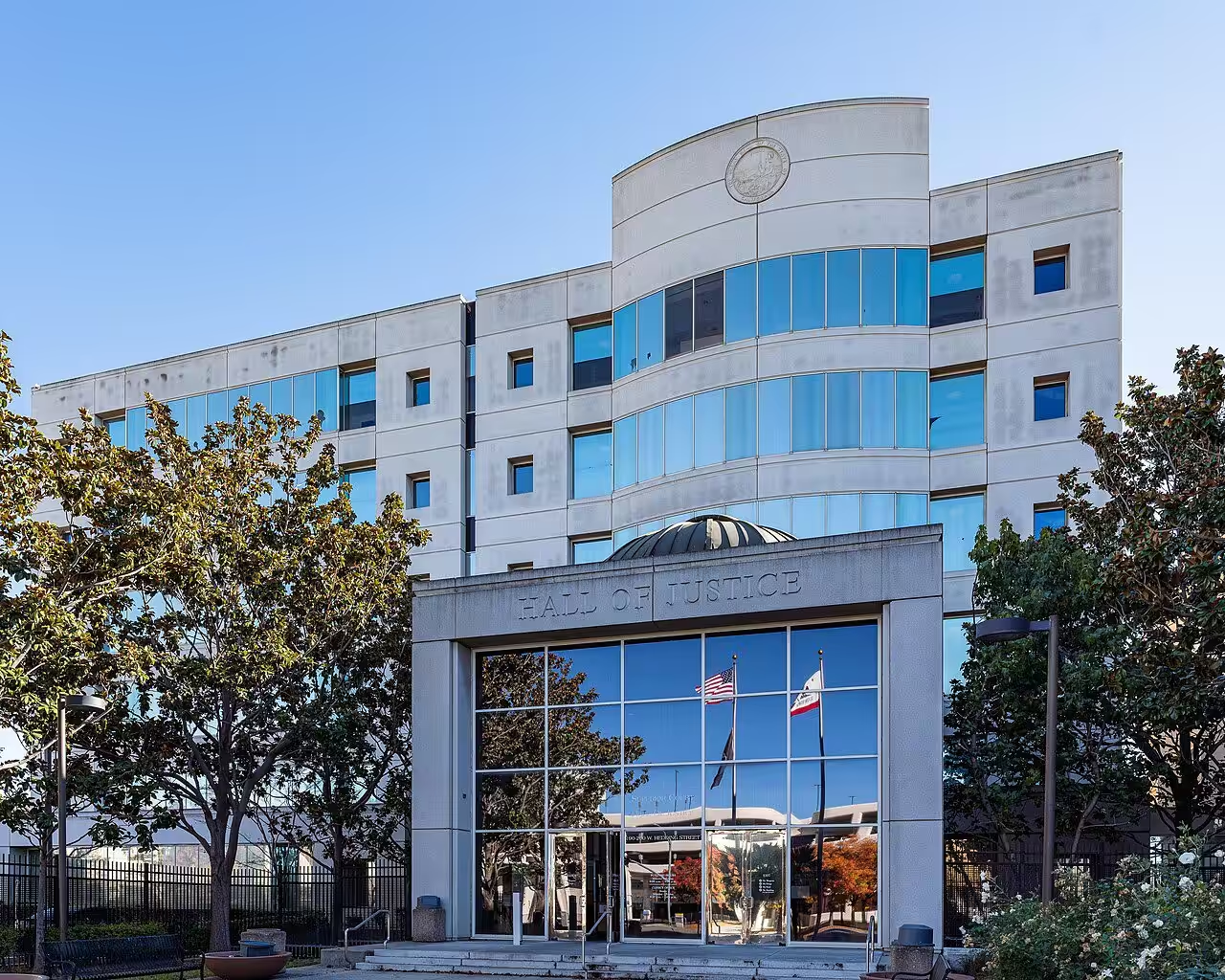
Image Attribution: “Santa Clara County Hall of Justice” by Unknown Author, via Wikimedia Commons, public domain