A Massachusetts Med Spa owner pleaded guilty to federal charges involving counterfeit Botox and dermal fillers after performing thousands of unlicensed injections between 2021 and 2025, receiving more than $1 million in client payments.
Med Spa Owner Used Counterfeit Injectables in Unlicensed Procedures
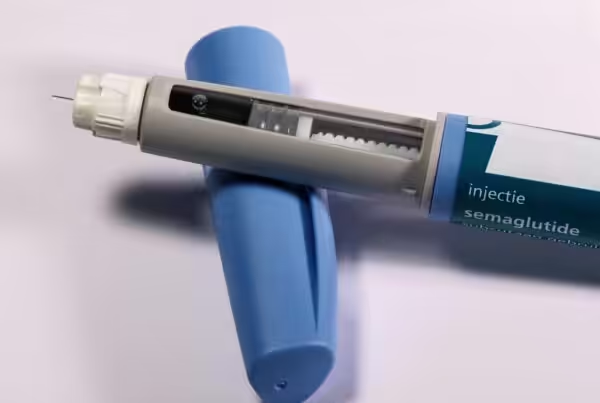
On April 7, 2026, the U.S. Attorney’s Office for the District of Massachusetts announced in a press release that a Massachusetts Med Spa owner pleaded guilty in federal court in Boston to charges involving counterfeit injectable products. Federal prosecutors said the defendant imported counterfeit Botox, Sculptra, and Juvéderm and performed thousands of injections between 2021 and 2025 while not licensed to do so. The defendant received more than $1 million in client payments for unlicensed injectable procedures commonly performed in Med Spa settings.
Massachusetts Med Spa Case Centers on Counterfeit Injectables and Unlicensed Practice
A Massachusetts Med Spa owner pleaded guilty to federal charges involving unlicensed procedures and counterfeit injectable products, as announced in an April 7, 2026, press release from the U.S. Attorney’s Office for the District of Massachusetts. The defendant was previously arrested and charged in November 2024.

The press release also shows that the defendant, Rebecca Fadanelli, pleaded guilty to four counts of importing merchandise contrary to law, two counts of selling or dispensing a counterfeit drug, and two counts of selling or dispensing a counterfeit medical device. U.S.
Charging documents and a federal criminal complaint state that, beginning in at least March 2021, the defendant imported counterfeit Botox, Sculptra, and Juvéderm from China and Brazil and administered them to clients at Skin Beaute Med Spa locations in Randolph and South Easton, Massachusetts. Records cited in the investigation show the defendant performed thousands of injection procedures and received more than $1 million in client payments.
The criminal complaint further states that the defendant was not licensed to administer injectable prescription drugs or devices and that aestheticians are not authorized to perform these types of procedures in Massachusetts. District Court Judge Julia E. Kobick scheduled sentencing for July 1, 2026.
Source Attribution
According to an April 7, 2026, press release from the U.S. Attorney’s Office for the District of Massachusetts, federal prosecutors announced that a Massachusetts Med Spa owner pleaded guilty to charges involving counterfeit injectable products and unlicensed medical procedures after being arrested and charged in November 2024.
Compliance Context: Licensing and Injectable Services
Court filings in this case cite federal statutes, including the Federal Food, Drug, and Cosmetic Act, which governs the distribution and administration of prescription drugs and medical devices, including injectable products such as Botox and dermal fillers. The filings state that the defendant, an aesthetician, was not licensed to perform injections or to dispense or administer prescription drugs or devices, and that she falsely represented herself to clients and employees as a nurse while performing these procedures.
The Massachusetts Board of Registration of Cosmetology and Barbering states that aestheticians may not perform medical or invasive procedures, including injections of substances such as Botox and dermal fillers, as these procedures fall outside their licensed scope of practice. Court documents also describe product sourcing practices involving imported injectable products later identified as counterfeit, with shipments flagged and seized by U.S. Customs and Border Protection and reviewed as part of the investigation.
The case reflects coordination among federal agencies, including the U.S. Food and Drug Administration’s Office of Criminal Investigations and U.S. Customs and Border Protection, as well as state licensing authorities. Similar enforcement activity has been documented in Med Spa inspections, including a February 2026 action in which New York regulators issued citations to 87 facilities for violations related to infection control, supervision, and scope of practice.
Board-level actions have also addressed compliance issues in clinical oversight, including a March 2026 Connecticut Nursing Board case involving infection control and supervision requirements in cosmetic procedures. This enforcement activity centers on practitioner qualifications, representation of credentials, and sourcing of prescription-based aesthetic products. These are areas where Med Spa operators and clinics remain subject to regulatory oversight.
Practical Implications for Med Spa Operators
Based on the case, these implications are directly tied to the oversight and compliance concerns identified:
- Ensure injectable procedures are performed only by practitioners licensed under state law to administer prescription drugs and devices.
- Maintain accurate representation of provider credentials to patients and staff, consistent with up-to-date licensure records.
- Source injectable products through authorized manufacturers or licensed distributors with documented supply chains.
- Maintain records of product procurement, inventory, and administration to support traceability of injectable products used in Med Spa services.
- Administer prescription drugs and devices in accordance with federal requirements and applicable state oversight.
What to Watch
Sentencing in this case is scheduled for July 1, 2026, in the U.S. District Court. For Med Spa operators, the outcome will determine the penalties associated with the charges, while existing federal and state requirements governing licensure, scope of practice, and injectable product sourcing remain in effect.
About Spakinect
Spakinect provides compliance infrastructure and telehealth-supported supervision solutions for medical aesthetic practices. For additional information, see our website.
Image Attribution:“Boston – Massachusetts State House” by Ajay Suresh, via Wikimedia Commons, licensed under CC BY 2.0.