

The September 2026 labeling update follows 129 adverse-event cases involving deoxycholic acid injections outside the submental region and adds warnings about serious reactions, nodules, and masses.
FDA Revises Kybella Label After Review of Adverse-Event Reports
On September 15, 2026, the FDA announced additional safety information in the labeling for Kybella, or deoxycholic acid injection, following reports involving use outside the approved submental region. For Med Spa and aesthetic practices offering Kybella, the update provides new safety guidance on treatment location and adverse reactions that may inform clinical protocols and patient counseling.
FDA Identified 129 Cases Involving Use Outside the Submental Region
Kybella was approved in 2015 to improve the appearance of moderate-to-severe fullness associated with submental fat in adults. The September 2026 prescribing information states that Kybella is not approved to treat subcutaneous fat outside the submental region and that this use is not recommended.
In its September 15, 2026 Drug Safety Communication, the FDA reported that since Kybella’s 2015 approval, it identified 129 adverse-event cases involving deoxycholic acid injections administered outside the approved submental region.
Serious events reported with use outside that area included:
- Blurred or reduced vision following injections around the eyes
- Muscle or nerve injuries, including facial weakness
- Abnormal sensation
In the same review, the FDA identified 117 cases of unresolved injection-site nodules or masses associated with deoxycholic acid injections. When those cases were reported, the nodules or masses had persisted for an average of 143 days, or about five months. Under the revised prescribing information, nodules are 3 centimeters or smaller, while masses are larger than 3 centimeters. Some may not resolve and may require medical intervention.
The labeling change addresses nodules and masses reported after injections both within the approved submental region and outside it. The FDA also states that Kybella and a generic deoxycholic acid injection product are the only FDA-approved drugs for improving the appearance of moderate-to-severe fullness associated with submental fat.
Source: FDA Drug Safety Communication
According to the FDA’s September 15, 2026 Drug Safety Communication, the agency revised Kybella labeling after reviewing adverse-event reports and medical literature involving deoxycholic acid injections.
FDA Kybella Update Adds Compliance Context for Injectable Practices
This FDA update shows how postmarket safety findings can lead to changes in the warnings and precautions for an approved injectable drug. The September 2026 update does not change Kybella’s approved indication but adds more specific safety information involving use outside the submental region and certain injection-site reactions.
Areas of focus in the updated labeling include:
- The distinction between Kybella’s approved submental use and unapproved use elsewhere on the body
- A new warning addressing serious adverse reactions associated with use outside the submental region
- Additional warnings and precautions involving injection-site nodules and masses
- Provider and patient awareness of adverse reactions associated with Kybella
The September 2026 update reinforces Kybella’s approved submental use and adds new safety information about adverse reactions linked to use outside the submental region.
Providers are also advised to counsel patients about adverse reactions that may require medical attention, including signs of marginal mandibular nerve injury, difficulty swallowing, and serious injection-site reactions. The revised labeling directs providers to discontinue Kybella if a patient develops an injection-site ulceration, necrosis, nodule, mass, or infection. Suspected adverse reactions can be reported through the FDA’s MedWatch program.
For Med Spa and aesthetic operators, the Kybella labeling update adds to broader product-safety considerations surrounding injectable treatments, particularly the importance of how a product is intended to be used and the adverse reactions that can occur when safety limitations are not followed. Separate product-safety concerns have also emerged through an FDA-posted recall involving injectable sodium chloride, while a Miami Med Spa enforcement case involved alleged unlicensed cosmetic injections and patient-reported complications. These involve different regulatory circumstances and highlight a distinct aspect of injectable safety in aesthetic practice.
Practical Implications for Med Spas Offering Kybella
- Review Kybella protocols using the September 2026 prescribing information.
- Reinforce patient education on approved use and potential adverse reactions.
- Confirm staff is familiar with current Kybella labeling and safety guidance.
- Evaluate consent and follow-up processes for alignment with updated information.
- Maintain a process for documenting and reporting suspected adverse reactions when appropriate.
What to Watch Next
The FDA continues to accept adverse-event reports involving deoxycholic acid injections through its MedWatch program. Any future FDA safety communications or revisions to Kybella prescribing information may provide official updates on the product’s safety guidance.
About Spakinect
Spakinect provides compliance infrastructure and telehealth-supported supervision solutions for medical aesthetic practices. For additional information, see our website.
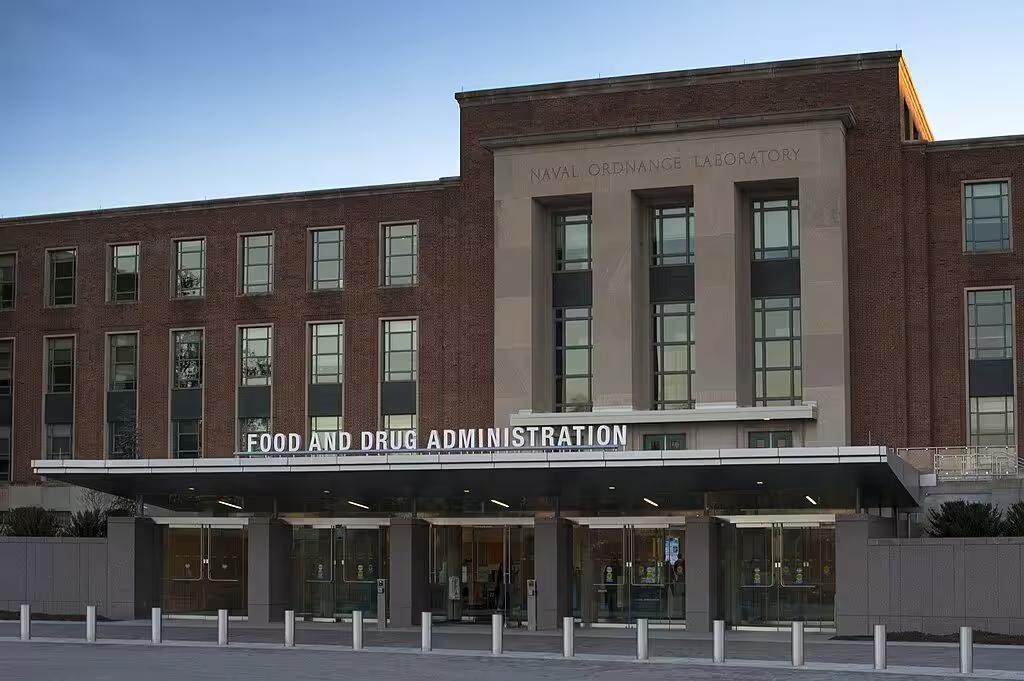
Image Attribution: “FDA Entrance” by The U.S. Food and Drug Administration, via Wikimedia Commons, public domain.